Estimate annual carbon credits and revenue from solar PV projects. Model grid emission factors, system efficiency and sun hours against Gold Standard GS4GG and Verra VCS assumptions.
Open calculator →Open the calculator without paying, create a free account to save assumptions, and unlock a professional PDF report when the result is ready to share.
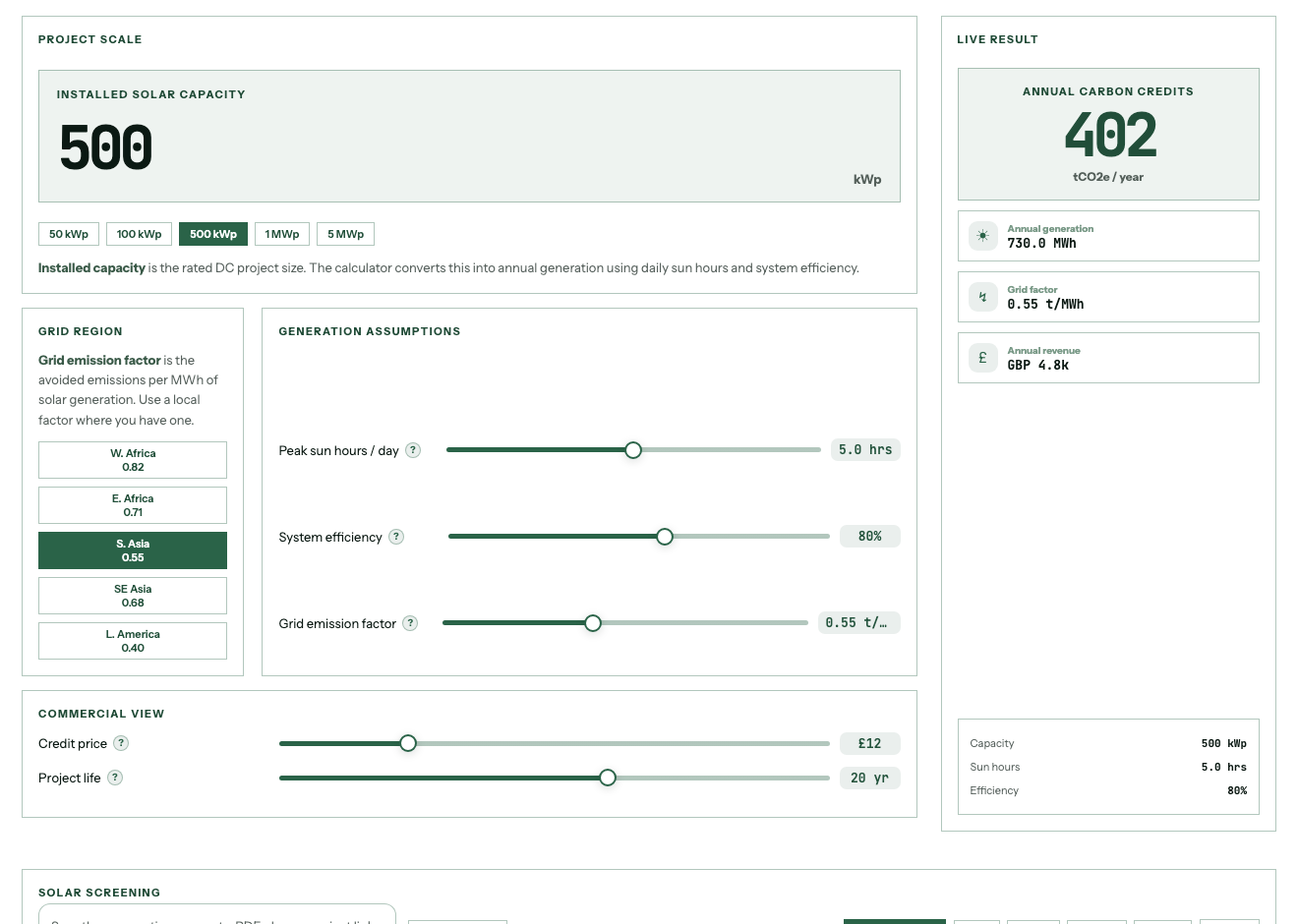
The Carbon Workbench solar calculator estimates the annual tCO₂e credits generated by a grid-connected solar PV project. It models the key variables that drive credit issuance - system capacity, peak sun hours, efficiency losses and the grid emission factor - and translates them into annual generation (MWh), carbon credits (tCO₂e) and projected revenue.
Solar carbon projects earn credits by displacing electricity that would otherwise have been generated by fossil fuels on the national grid. The emission factor for that grid - measured in tCO₂e per MWh - is the single most important variable in calculating credit yield. A high-carbon grid in sub-Saharan Africa or South Asia can generate four to five times more credits per MWh than a low-carbon European grid.
The core formula follows the Gold Standard GS4GG and Verra VCS approach for renewable energy projects:
Both Gold Standard and Verra require the emission factor to be sourced from an approved database and updated periodically. Many national grids are decarbonising year on year, which reduces credit yield over a project's lifetime - the calculator uses a fixed emission factor, so treat projections as conservative estimates for near-term years and optimistic for later years on rapidly-decarbonising grids.
The calculator gives a simplified credit estimate. A formal submission will also need to account for:
The grid emission factor is the biggest driver of credit yield for solar projects. Here are representative values for key markets - always verify against the most recent approved database for your standard:
| Region / country | Grid EF (tCO₂e/MWh) | Source |
|---|---|---|
| Sub-Saharan Africa (average) | 0.60 – 0.85 | IEA / CDM Tool 07 |
| South Asia (India, Bangladesh) | 0.70 – 0.82 | CEA / national BUR |
| Southeast Asia (Vietnam, Philippines) | 0.50 – 0.75 | IEA / CDM Tool 07 |
| Latin America (Colombia, Peru) | 0.20 – 0.45 | UPME / COES |
| UK | 0.19 – 0.23 | DESNZ 2024 |
| EU average | 0.25 – 0.35 | EEA / AIB |
Projects in Sub-Saharan Africa and South Asia generate the highest credit volumes per MWh installed - four to five times more than UK or EU projects - making them the primary targets for Gold Standard solar carbon projects.
Solar carbon credits trade at a significant discount to newer removal methodologies like biochar or DACCS, primarily because they are well-understood, low-risk credits with large supply. Typical ranges in 2026:
| Standard | Credit type | Price range (2026) |
|---|---|---|
| Gold Standard GS4GG | Verified Emission Reduction (VER) | £8 – £18 / tCO₂e |
| Verra VCS | Verified Carbon Unit (VCU) | £4 – £12 / tCO₂e |
| Gold Standard + SDG labels | VER with SDG impact claims | £12 – £25 / tCO₂e |
Gold Standard commands a premium over Verra VCS for solar projects, largely because of its stricter additionality requirements and co-benefit certification. If your project is in a community setting with measurable health, gender or livelihoods impacts, pursuing Gold Standard is usually worth the additional cost.
Both standards are well-suited to solar projects but have different strengths:
Use the Methodology Selector to get a tailored recommendation for your project location, scale and buyer target.
| System size | Example location | Annual generation | Annual credits (tCO₂e) | Annual revenue (£ at £12/t) |
|---|---|---|---|---|
| 10 kWp | Kenya (EF 0.70) | 15 MWh | 10.5 t | £126 |
| 100 kWp | Kenya (EF 0.70) | 150 MWh | 105 t | £1,260 |
| 500 kWp | Kenya (EF 0.70) | 750 MWh | 525 t | £6,300 |
| 1 MWp | India (EF 0.80) | 1,460 MWh | 1,168 t | £14,016 |
| 10 MWp | India (EF 0.80) | 14,600 MWh | 11,680 t | £140,160 |
These figures assume 5 peak sun hours/day and 80% system efficiency. Actual results will vary by location, equipment and monitoring period. Enter your specific values in the calculator for a more accurate estimate.
Enter your system capacity, location and grid emission factor to get instant credit estimates, saved runs and exportable outputs.
Open calculator →