Know what verification will cost before you commit. Estimate VVB fees, registry charges and net revenue for Gold Standard, Verra VCS, Puro.earth and Plan Vivo projects.
Open calculator →Run the estimator without paying, create a free account to save assumptions, and unlock a professional PDF report when the cost stack is ready to share.
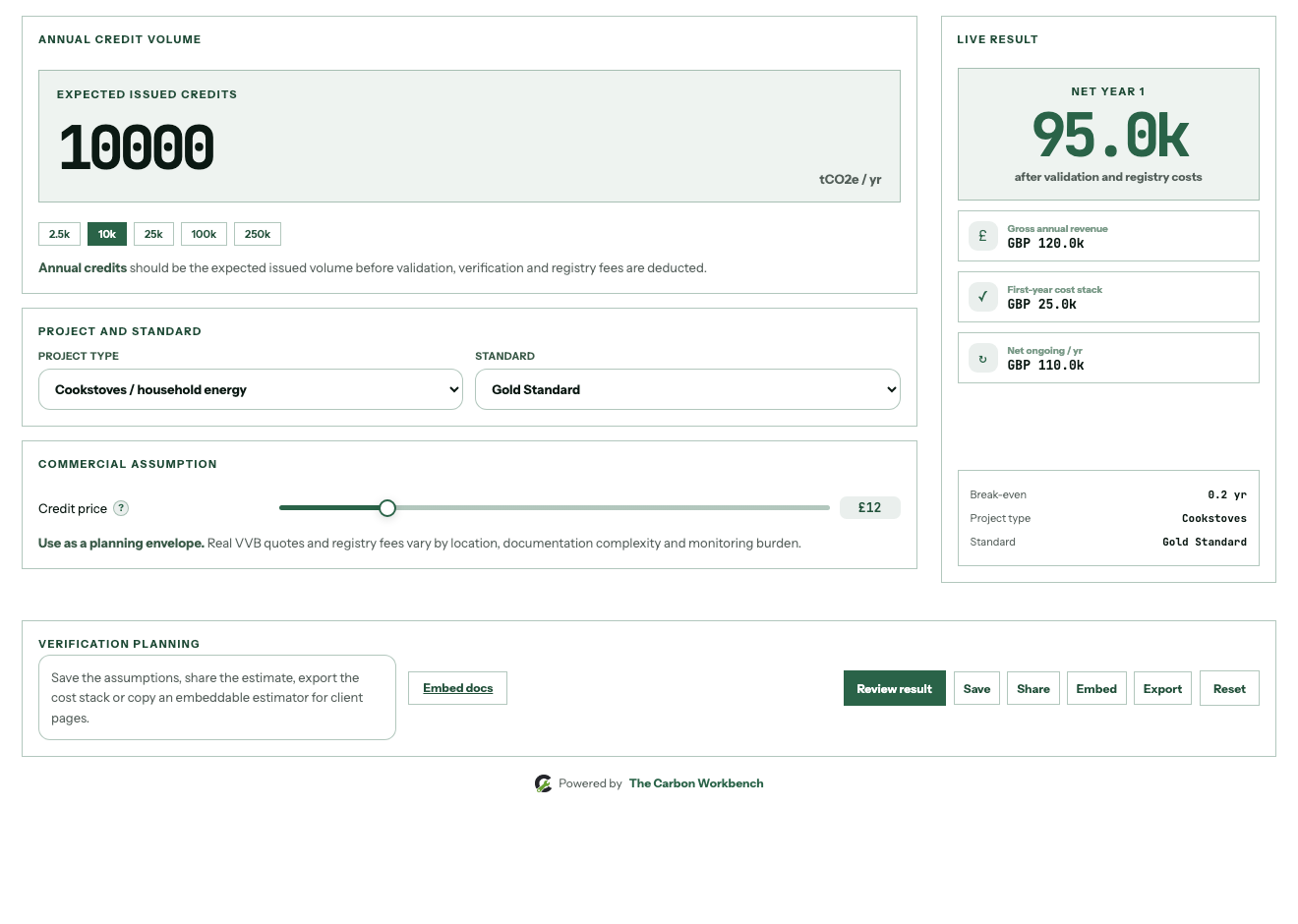
Carbon project verification is expensive, and many first-time developers are surprised by the full cost. A Gold Standard validation alone can cost £15,000–£25,000 before you've issued a single credit. Annual verification - required every monitoring period - adds £6,000–£15,000 per year on top. For small projects generating fewer than 5,000 tCO₂e per year, these fixed costs can eliminate most or all of the revenue.
The Carbon Workbench Verification Cost Estimator lets you enter your expected annual credit volume and chosen standard, and instantly calculates whether your project is financially viable - including break-even year, net year-one revenue, and lifetime return.
VVB fees vary significantly by standard, project complexity, project country and the specific VVB. The figures below are representative ranges based on published fee schedules from TÜV Rheinland, SCS Global Services, Carbon Check and similar accredited bodies. Always obtain at least two competitive quotes before committing to a VVB.
| Standard | Validation (one-off) | Annual verification | Registry fee |
|---|---|---|---|
| Gold Standard GS4GG | £15,000 – £25,000 | £8,000 – £15,000 | 5 – 7% of credit value |
| Verra VCS | £10,000 – £20,000 | £6,000 – £12,000 | 4 – 6% of credit value |
| Puro.earth | £8,000 – £18,000 | £5,000 – £10,000 | 6 – 10% of credit value |
| Plan Vivo | £5,000 – £12,000 | £4,000 – £8,000 | 4 – 6% of credit value |
Puro.earth charges a higher registry fee percentage than Verra or Gold Standard but offers significantly higher credit prices for biochar and other carbon removal methods, often making it the most profitable option for eligible project types despite the higher fees.
Given the fixed costs of validation and annual verification, there is a minimum credit volume below which most projects are financially unviable. As a rough guide at 2026 market prices:
| Standard | Credit price range | Minimum viable volume | Approximate break-even |
|---|---|---|---|
| Gold Standard GS4GG | £10 – £20 / tCO₂e | 3,000 – 5,000 t/yr | Year 2 – 3 |
| Verra VCS | £5 – £12 / tCO₂e | 5,000 – 10,000 t/yr | Year 2 – 4 |
| Puro.earth (biochar) | £60 – £120 / tCO₂e | 500 – 1,500 t/yr | Year 1 – 2 |
| Plan Vivo | £8 – £15 / tCO₂e | 2,000 – 4,000 t/yr | Year 2 – 3 |
These are indicative thresholds. The actual break-even depends heavily on the specific VVB quote obtained, the complexity of your project design document, and whether you are bundling multiple monitoring periods into a single verification visit.
A common rule of thumb used by project developers is that verification costs should not exceed 15–20% of gross annual revenue. For a project generating 10,000 tCO₂e per year at £12/t (£120,000 gross revenue), this means total annual verification costs should stay below £18,000–£24,000. Use the estimator to check where your project sits:
| Annual credits | Gross revenue (£12/t) | Typical ver. costs (GS) | Net revenue | Cost as % revenue |
|---|---|---|---|---|
| 2,000 t | £24,000 | £23,000 | £1,000 | 96% |
| 5,000 t | £60,000 | £27,000 | £33,000 | 45% |
| 10,000 t | £120,000 | £32,000 | £88,000 | 27% |
| 25,000 t | £300,000 | £42,000 | £258,000 | 14% |
| 50,000 t | £600,000 | £55,000 | £545,000 | 9% |
Year one costs include the one-off validation fee. From year two, costs drop as validation is not repeated, improving net revenue significantly. The estimator calculates both year-one and steady-state figures so you can see the full picture.
Enter your annual credit volume and standard to get instant net revenue and break-even calculations.
Open calculator →