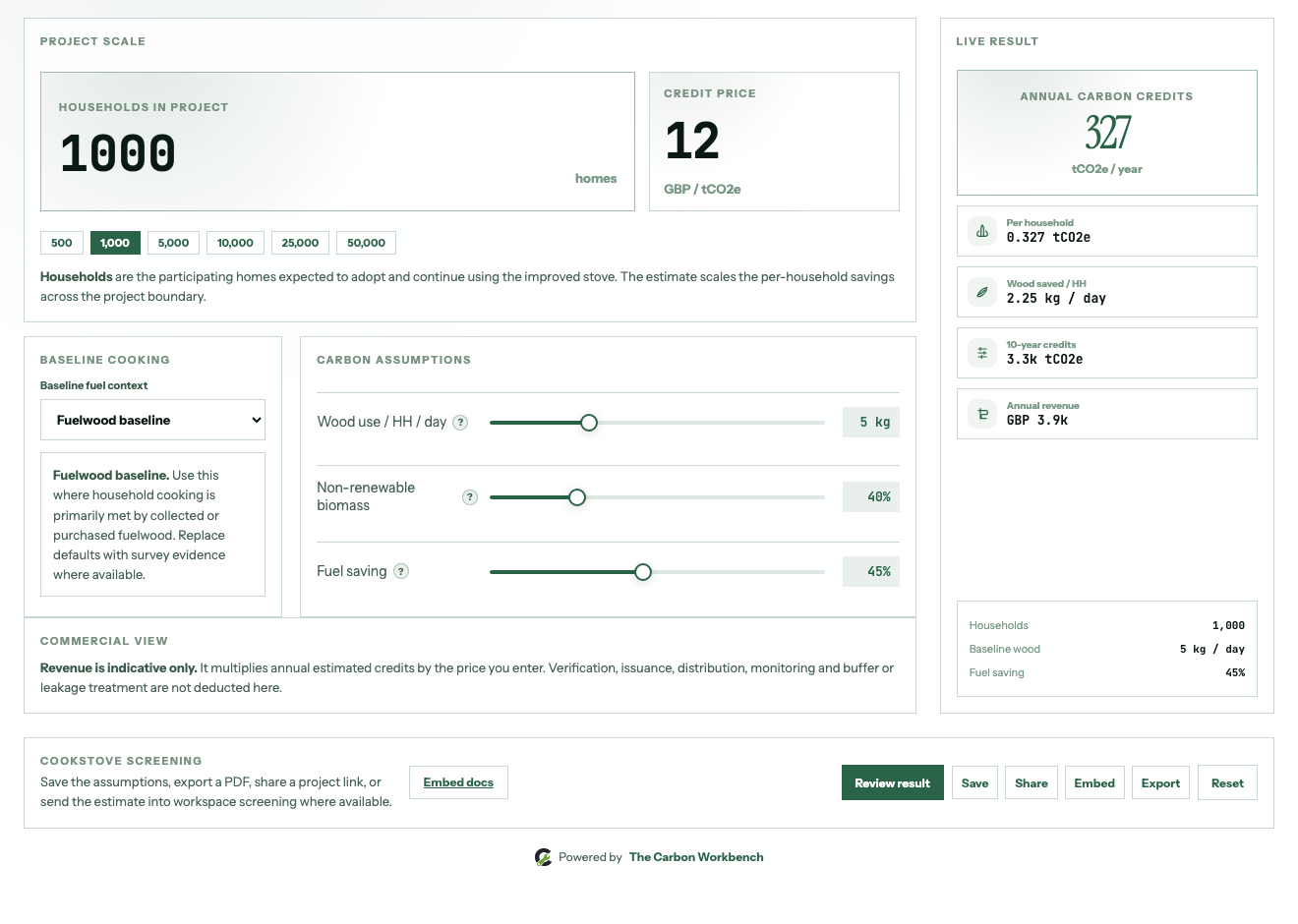
What are cookstove carbon credits?
Improved cookstove projects replace traditional open-fire cooking with more efficient stoves that use less firewood or charcoal. The reduction in non-renewable biomass burning generates verified carbon credits that can be sold on the voluntary carbon market to fund the project and provide returns to the developer.
Cookstove projects are one of the most established project types in the voluntary carbon market, with hundreds of registered projects under both the Gold Standard and Verra Verified Carbon Standard. They generate strong sustainable development co-benefits including health improvements (reduced indoor air pollution), time savings for women and children, and reduced deforestation pressure.
How are cookstove credits calculated?
The standard credit calculation for a cookstove project follows the CDM AMS-II.G methodology (adopted by Gold Standard GS4GG):
- Baseline wood consumption - the amount of wood burned per household per day using the traditional cooking method (typically 5–12 kg/day)
- Non-renewable biomass (NRB) fraction - the proportion of that wood that would not have regenerated naturally, typically 50–85% in sub-Saharan Africa and South Asia
- Fuel saving - the percentage reduction in fuel use achieved by the improved stove (typically 30–60%)
- Household count - the number of households with consistently adopted stoves
Annual credits (tCO₂e) = Households × Wood saved (kg/day) × 365 × NRB fraction × 0.001 × CO₂e factor
Typical credit yields by stove type
| Stove technology | Fuel saving | tCO₂e / household / year | Typical credit price |
|---|
| Rocket stove (basic) | 30–40% | 1.2–2.0 | £8–12/t |
| Improved biomass stove | 40–50% | 1.8–2.8 | £8–14/t |
| Gasifier / TLUD stove | 50–65% | 2.5–3.5 | £10–18/t |
| LPG / clean fuel switch | 70–90% | 3.0–5.0 | £12–20/t |
| Electric induction (solar) | 85–95% | 2.5–4.0 | £15–25/t |
Gold Standard vs Verra for cookstove projects
Both standards certify cookstove credits but with different emphases:
- Gold Standard GS4GG - preferred by most buyers due to strong SDG co-benefits (health, gender, livelihoods). Credits typically trade at a 20–40% premium over Verra. Requires rigorous monitoring via kitchen performance tests (KPT) or stove usage monitors (SUM). Best for community-focused projects targeting ESG buyers.
- Verra VCS - higher volumes, lower prices. Note that the ICVCM's Core Carbon Principles (CCP) framework has raised the bar for cookstove monitoring requirements under VCS. Check current methodology eligibility before committing.
Monitoring and verification requirements
Cookstove projects require ongoing monitoring to demonstrate that stoves are still being used and maintained. Typical requirements include:
- Annual kitchen performance tests (KPT) on a sample of households
- Stove usage monitor (SUM) data from electronic sensors in a monitoring sub-sample
- Household surveys to track adoption rates and stove condition
- Annual verification by an accredited VVB (Validation and Verification Body)
Estimate your cookstove project credits free
Enter household count, stove type and fuel saving. Get annual credits and revenue in seconds.
Open calculator →
Related tools