Estimate safe-water carbon credit volume from household reach, boiling behaviour, borehole uptime and avoided non-renewable fuel use before you commit to deeper project development.
Open the calculator to test assumptions. Create a free account to save useful work, then unlock a professional report only when the project is ready.
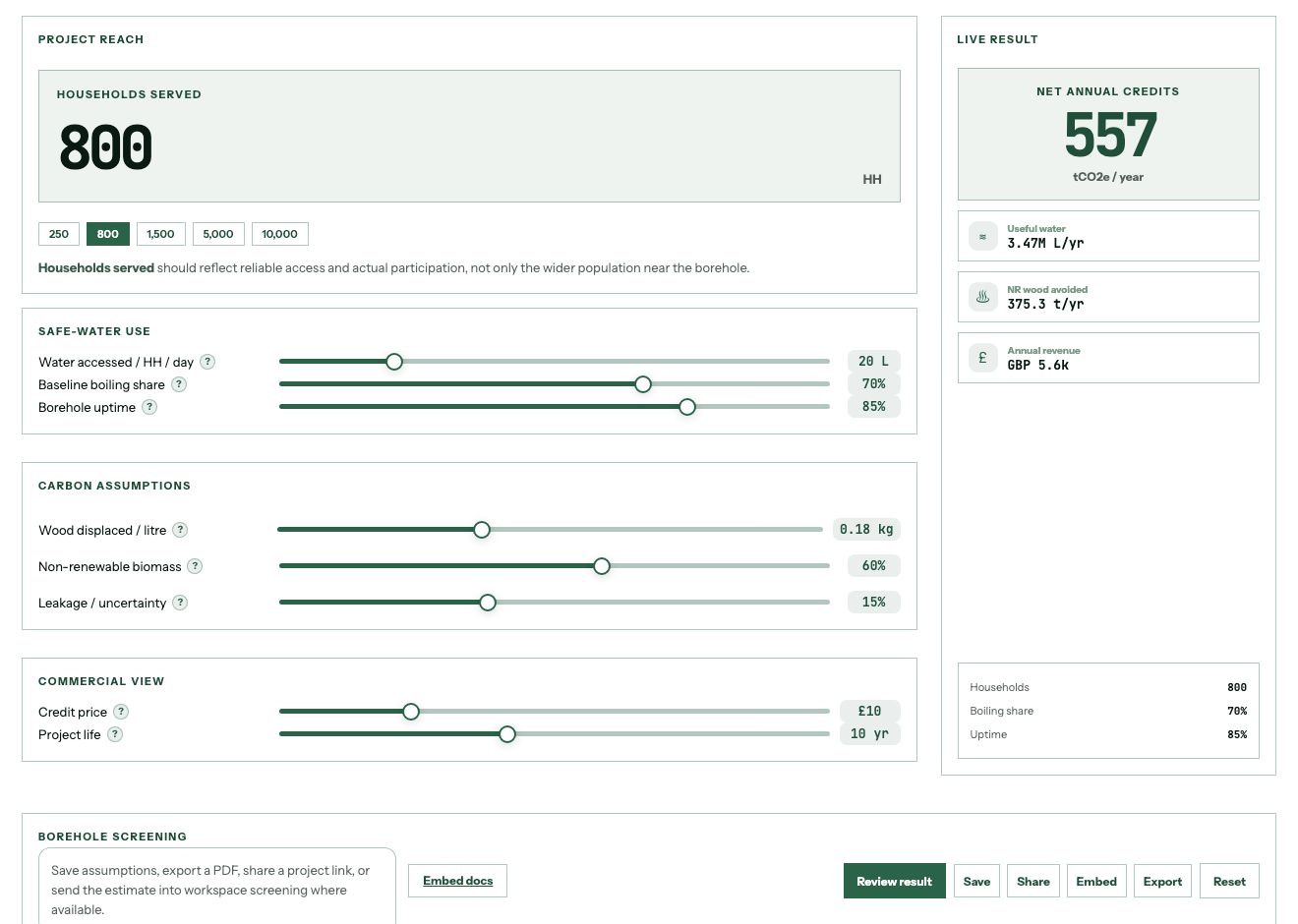
The Borehole Project Calculator is built for early-stage safe-water modelling. It helps teams test whether a project is likely to generate commercially meaningful annual credits, whether the assumptions look credible enough for diligence, and which variables need stronger field evidence before anything is shared externally.
This is a first-pass model rather than a registry submission engine. It is most useful when commercial, sales and technical teams need a fast answer on whether a borehole opportunity deserves further work.
The model estimates useful water delivered, applies the share that would otherwise have been boiled, translates that displaced boiling activity into wood savings, then applies the non-renewable biomass share and emissions factor. Uptime and deduction settings bring the gross result back toward a more conservative operational estimate.
| Step | Purpose |
|---|---|
| Useful water delivered | Converts households, daily water access, boiling share and uptime into the annual water volume used by the model. |
| Wood displaced | Uses wood-per-litre assumptions to estimate the baseline fuel displaced by reliable safe-water access. |
| Non-renewable share | Applies the share of biomass that counts toward avoided fossil-equivalent emissions. |
| Gross credits | Translates displaced non-renewable wood into annual tCO₂e using the emissions factor in the tool. |
| Net credits | Applies deduction settings so the result is directionally conservative rather than promotional. |
Use the Borehole Project Calculator when a project is too early for detailed diligence but important enough to warrant a first-pass commercial model. That includes inbound sales conversations, donor or partner opportunity review, early funder conversations and internal triage before technical teams are asked to spend time on methodology or monitoring design.
If the modelled number looks credible, the next step is not usually to publish it. The stronger path is to test methodology fit, verification burden and buyer readiness, then unlock a professional report when the project is ready to share.
Open the Borehole Project Calculator, then test stronger projects against methodology, verification and commercial evidence requirements.
Open calculator →