Test whether a carbon project is commercially worth taking further by modelling credit volume, pricing, costs, project life and break-even timing.
Open calculator →Test credit volume, pricing, costs, project life and break-even timing without paying. Create a free account to save scenarios, then unlock a professional PDF report when needed.
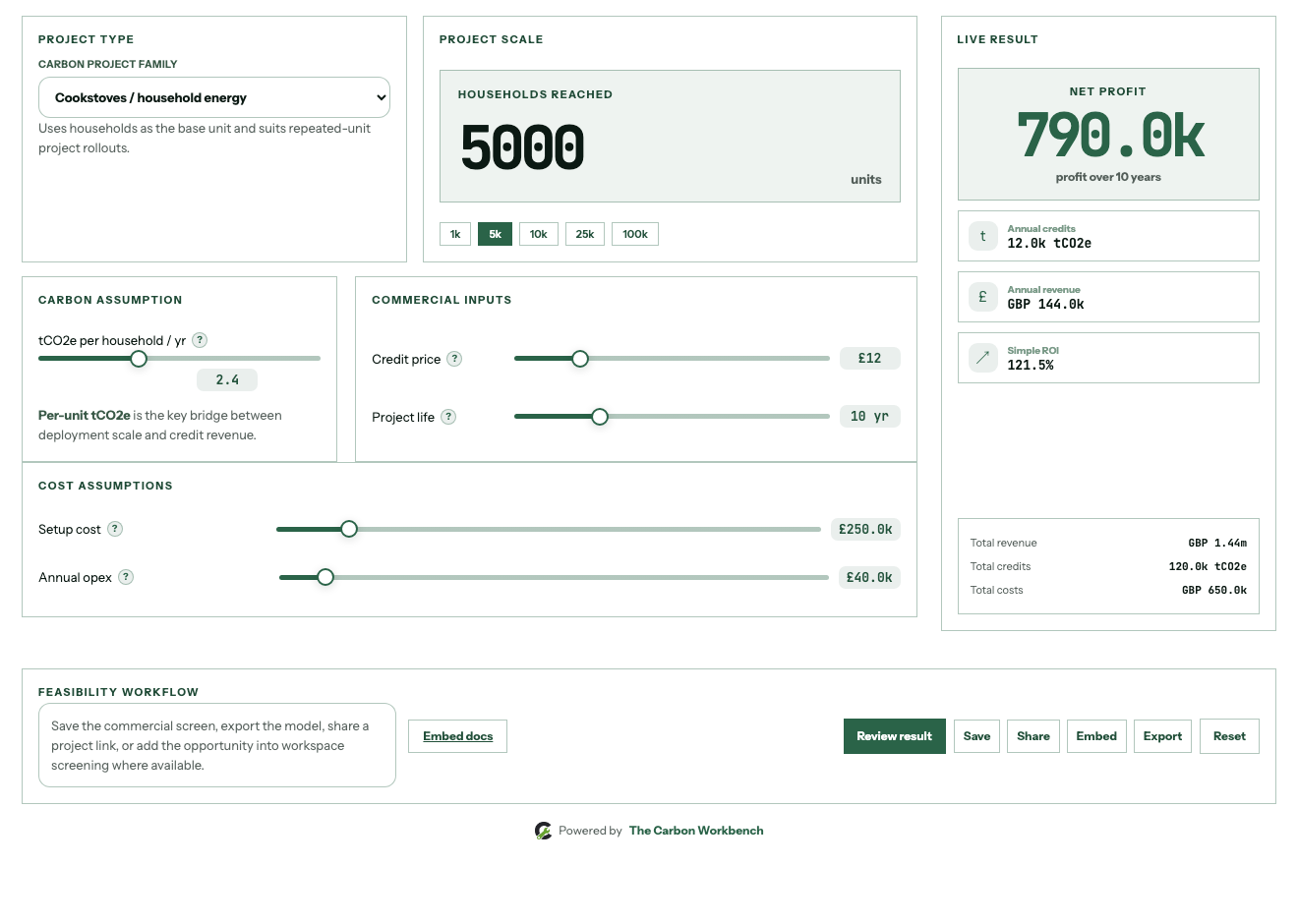
This calculator is for project developers, consultants and early-stage teams who need a fast commercial assessment before investing more time in methodology, validation or buyer conversations. It is especially useful when a project looks promising technically but the economics are still uncertain.
Use it as a decision filter, not a pitch deck tool. A useful feasibility model tells you when the project is too small, too margin-sensitive or too dependent on optimistic prices.
| Variable | Why it matters |
|---|---|
| Annual credit volume | Sets the revenue ceiling and determines whether fixed certification costs can be absorbed. |
| Price range | Shows whether the project only works at premium assumptions or clears under realistic market conditions. |
| Project life | Affects total value capture and whether validation costs are spread over a long enough period. |
| Break-even timing | Highlights whether the project is commercially financeable, not just profitable on paper. |
If you have a plausible methodology route and a rough annual volume estimate, the first job is to see whether the project still works once price and time are modelled more realistically.
If the economics only work at the top of the market, that is usually the first warning sign. The modeller is most useful when it exposes those fragile cases early.
It is often not obvious whether a project is fundamentally weak or simply too small. Running multiple scale assumptions helps answer that quickly.
Open the modeller in The Carbon Workbench to test project life, revenue assumptions, margin sensitivity and break-even timing.
Open calculator →No. It is designed as a cross-project commercial modelling layer, which makes it useful after methodology and credit-volume assumptions are already directionally clear.
Use them together. Feasibility gives you the commercial frame; verification costs make that frame more realistic.
No. It is a first-pass assessment designed to tell you whether the project deserves deeper work.
